
In questa pagina spieghiamo cosa sono gli autovalori e gli autovettori, chiamati anche rispettivamente autovalori e autovettori. Troverai anche esempi su come calcolarli ed esercizi risolti passo dopo passo per esercitarti.
Che cosa sono un autovalore e un autovettore?
Sebbene la nozione di autovalore e autovettore sia difficile da comprendere, la sua definizione è la seguente:
Gli autovettori o autovettori sono i vettori diversi da zero di una mappa lineare che, trasformati da essa, danno origine a un multiplo scalare di essi (non cambiano direzione). Questo scalare è l’ autovalore o autovalore .

Oro

è la matrice della mappa lineare,

è l’autovettore e

proprio valore.
L’autovalore è noto anche come valore caratteristico. E ci sono anche matematici che usano la radice tedesca “eigen” per designare autovalori e autovettori: autovalori per autovalori e autovettori per autovettori.
Come calcolare gli autovalori (o autovalori) e gli autovettori (o autovettori) di una matrice?
Per trovare gli autovalori e gli autovettori di una matrice bisogna seguire tutta una procedura:
- L’equazione caratteristica della matrice si calcola risolvendo il seguente determinante:
- Troviamo le radici del polinomio caratteristico ottenuto nel passaggio 1. Queste radici sono gli autovalori della matrice.
- Viene calcolato l’autovettore di ciascun autovalore. Per fare ciò, per ciascun autovalore viene risolto il seguente sistema di equazioni:



Questo è il metodo per trovare gli autovalori e gli autovettori di una matrice, ma qui vi diamo anche alcuni consigli: 😉
Consigli : possiamo sfruttare le proprietà degli autovalori e degli autovettori per calcolarli più facilmente:
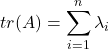
✓ La traccia della matrice (somma della sua diagonale principale) è uguale alla somma di tutti gli autovalori.
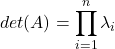
✓ Il prodotto di tutti gli autovalori è uguale al determinante della matrice.
✓ Se esiste una combinazione lineare tra righe o colonne, almeno un autovalore della matrice è uguale a 0.
Vediamo un esempio di come si calcolano gli autovettori e gli autovalori di una matrice per comprendere meglio il metodo:
Esempio di calcolo degli autovalori e degli autovettori di una matrice:
- Trova gli autovalori e gli autovettori della seguente matrice:
![\displaystyle A= \begin{pmatrix}1&0\\[1.1ex] 5&2\end{pmatrix}](https://mathority.org/wp-content/ql-cache/quicklatex.com-e82dbe4f6e975e1374cab2c1b74638b9_l3.png "Rendered by QuickLaTeX.com")
Per prima cosa dobbiamo trovare l’equazione caratteristica della matrice. E, per questo, deve essere risolto il seguente determinante:
![\displaystyle \text{det}(A-\lambda I)= \begin{vmatrix}1- \lambda &0\\[1.1ex] 5&2-\lambda \end{vmatrix} = \lambda^2-3\lambda +2](https://mathority.org/wp-content/ql-cache/quicklatex.com-283812fe5eed97f58568fb6e515e3ff5_l3.png "Rendered by QuickLaTeX.com")
Ora calcoliamo le radici del polinomio caratteristico, quindi uguagliamo il risultato ottenuto a 0 e risolviamo l’equazione:

![\lambda= \cfrac{-(-3)\pm \sqrt{(-3)^2-4\cdot 1 \cdot 2}}{2\cdot 1} = \cfrac{+3\pm 1}{2}=\begin{cases} \lambda = 1 \\[2ex] \lambda = 2 \end{cases}](https://mathority.org/wp-content/ql-cache/quicklatex.com-fdee5858b8b0187078ea372d9362900f_l3.png "Rendered by QuickLaTeX.com")
Le soluzioni dell’equazione sono gli autovalori della matrice.
Una volta ottenuti gli autovalori, calcoliamo gli autovettori. Per fare ciò, dobbiamo risolvere il seguente sistema per ciascun autovalore:
Per prima cosa calcoleremo l’autovettore associato all’autovalore 1:
![\displaystyle (A-1 I)\begin{pmatrix}x \\[1.1ex] y \end{pmatrix} =}\begin{pmatrix}0 \\[1.1ex] 0 \end{pmatrix}](https://mathority.org/wp-content/ql-cache/quicklatex.com-4f0cbd7a7e0670410881dcc0bfd4969c_l3.png "Rendered by QuickLaTeX.com")
![\displaystyle \begin{pmatrix}0&0\\[1.1ex] 5&1\end{pmatrix}\begin{pmatrix}x \\[1.1ex] y \end{pmatrix} =}\begin{pmatrix}0 \\[1.1ex] 0 \end{pmatrix}](https://mathority.org/wp-content/ql-cache/quicklatex.com-e1f49b7ecec643964e4a14cd17ddecb4_l3.png "Rendered by QuickLaTeX.com")
![\displaystyle \left.\begin{array}{l} 0x+0y = 0 \\[2ex] 5x+y = 0\end{array}\right\}](https://mathority.org/wp-content/ql-cache/quicklatex.com-06473aeaa487551bca2eb98ff786c8f5_l3.png "Rendered by QuickLaTeX.com")
Da queste equazioni si ottiene il seguente sottospazio:

I sottospazi degli autovettori sono anche chiamati autospazi.
Ora dobbiamo trovare una base di questo spazio pulito, quindi diamo ad esempio il valore 1 alla variabile

e otteniamo il seguente autovettore:

![\displaystyle v = \begin{pmatrix}1 \\[1.1ex] -5\end{pmatrix}](https://mathority.org/wp-content/ql-cache/quicklatex.com-8af03064a8f197990df832e71472cab0_l3.png "Rendered by QuickLaTeX.com")
Infine, una volta trovato l’autovettore associato all’autovalore 1, ripetiamo il processo per calcolare l’autovettore per l’autovalore 2:
![\displaystyle (A-2I)\begin{pmatrix}x \\[1.1ex] y \end{pmatrix} =}\begin{pmatrix}0 \\[1.1ex] 0 \end{pmatrix}](https://mathority.org/wp-content/ql-cache/quicklatex.com-3d52ccfc2cbc996d3844af6c699a81b2_l3.png "Rendered by QuickLaTeX.com")
![\displaystyle \begin{pmatrix}-1&0\\[1.1ex] 5&0\end{pmatrix}\begin{pmatrix}x \\[1.1ex] y \end{pmatrix} =}\begin{pmatrix}0 \\[1.1ex] 0 \end{pmatrix}](https://mathority.org/wp-content/ql-cache/quicklatex.com-24442a53901cc9f0622aecf66ef2dc25_l3.png "Rendered by QuickLaTeX.com")
![\displaystyle \left.\begin{array}{l} -x+0y = 0 \\[2ex] 5x+0y = 0\end{array}\right\} \longrightarrow \ x=0](https://mathority.org/wp-content/ql-cache/quicklatex.com-fbd3a434bf3f89ed38a893a98befee97_l3.png "Rendered by QuickLaTeX.com")
In questo caso solo la prima componente del vettore deve essere 0, quindi possiamo dare qualsiasi valore

. Ma per semplificare è meglio mettere 1:
![\displaystyle v = \begin{pmatrix}0 \\[1.1ex] 1 \end{pmatrix}](https://mathority.org/wp-content/ql-cache/quicklatex.com-f47b6a21a448d003d909c0c1c969b8f6_l3.png "Rendered by QuickLaTeX.com")
In conclusione gli autovalori e gli autovettori della matrice sono:
![\displaystyle \lambda = 1 \qquad v = \begin{pmatrix}1 \\[1.1ex] -5 \end{pmatrix}](https://mathority.org/wp-content/ql-cache/quicklatex.com-1668ed5f36ad0a8fcb28a264c76b6163_l3.png "Rendered by QuickLaTeX.com")
![\displaystyle \lambda = 2 \qquad v = \begin{pmatrix}0 \\[1.1ex] 1 \end{pmatrix}](https://mathority.org/wp-content/ql-cache/quicklatex.com-56b0287c0bea71a1e5a258373aaa47d9_l3.png "Rendered by QuickLaTeX.com")
Una volta che sai come trovare gli autovalori e gli autovettori di una matrice, potresti chiederti… e a cosa servono? Ebbene, risulta che sono molto utili per la diagonalizzazione delle matrici , infatti questa è la loro applicazione principale. Per saperne di più ti consigliamo di consultare come diagonalizzare una matrice con il collegamento, dove viene spiegato passo dopo passo il procedimento e ci sono anche esempi ed esercizi risolti per esercitarsi.
Esercizi risolti su autovalori e autovettori (autovalori e autovettori)
Esercizio 1
Calcola gli autovalori e gli autovettori della seguente matrice quadrata di ordine 2:
![\displaystyle A= \begin{pmatrix}3&1\\[1.1ex] 2&4\end{pmatrix}](https://mathority.org/wp-content/ql-cache/quicklatex.com-0c6e3869ea2848140f026afc2ff8d554_l3.png "Rendered by QuickLaTeX.com")
Per prima cosa calcoliamo il determinante della matrice meno λ sulla sua diagonale principale:
![\displaystyle \text{det}(A-\lambda I)= \begin{vmatrix}3- \lambda &1\\[1.1ex] 2&4-\lambda \end{vmatrix} = \lambda^2-7\lambda +10](https://mathority.org/wp-content/ql-cache/quicklatex.com-fadce42062bb04b7477318fdc35c4285_l3.png "Rendered by QuickLaTeX.com")
Calcoliamo ora le radici del polinomio caratteristico:
![\displaystyle \lambda^2-7\lambda +10=0 \ \longrightarrow \ \begin{cases} \lambda = 2 \\[2ex] \lambda = 5 \end{cases}](https://mathority.org/wp-content/ql-cache/quicklatex.com-7139127430fa6b78b78715d57a6fdf1f_l3.png "Rendered by QuickLaTeX.com")
Calcoliamo l’autovettore associato all’autovalore 2:

![\displaystyle \begin{pmatrix}1&1\\[1.1ex] 2&2\end{pmatrix}\begin{pmatrix}x \\[1.1ex] y \end{pmatrix} =}\begin{pmatrix}0 \\[1.1ex] 0 \end{pmatrix}](https://mathority.org/wp-content/ql-cache/quicklatex.com-614f9247b0d79635f70ec79eaa8c6529_l3.png "Rendered by QuickLaTeX.com")
![\displaystyle \left.\begin{array}{l} x+y = 0 \\[2ex] 2x+2y = 0\end{array}\right\} \longrightarrow \ x=-y](https://mathority.org/wp-content/ql-cache/quicklatex.com-272495fa6e8f89ba4e7c6a6d848cb38a_l3.png "Rendered by QuickLaTeX.com")
![\displaystyle v = \begin{pmatrix}1 \\[1.1ex] -1 \end{pmatrix}](https://mathority.org/wp-content/ql-cache/quicklatex.com-77c240aaa8b75f1e5353c295ee86ad50_l3.png "Rendered by QuickLaTeX.com")
E poi calcoliamo l’autovettore associato all’autovalore 5:

![\displaystyle \begin{pmatrix}-2&1\\[1.1ex] 2&-1\end{pmatrix}\begin{pmatrix}x \\[1.1ex] y \end{pmatrix} =}\begin{pmatrix}0 \\[1.1ex] 0 \end{pmatrix}](https://mathority.org/wp-content/ql-cache/quicklatex.com-b8aa7cae3057d78343128cd1095df24e_l3.png "Rendered by QuickLaTeX.com")
![\displaystyle \left.\begin{array}{l} -2x+y = 0 \\[2ex] 2x-y = 0\end{array}\right\} \longrightarrow \ y=2x](https://mathority.org/wp-content/ql-cache/quicklatex.com-d8c38e500cf7103b1dc0e91ea1b4531a_l3.png "Rendered by QuickLaTeX.com")
![\displaystyle v = \begin{pmatrix}1 \\[1.1ex] 2 \end{pmatrix}](https://mathority.org/wp-content/ql-cache/quicklatex.com-8be56f81b5aef28783636f85c4dbd643_l3.png "Rendered by QuickLaTeX.com")
Pertanto gli autovalori e gli autovettori della matrice A sono:
![\displaystyle \lambda = 2 \qquad v = \begin{pmatrix}1 \\[1.1ex] -1 \end{pmatrix}](https://mathority.org/wp-content/ql-cache/quicklatex.com-cde889d89562f2e42bd6610b0045c118_l3.png "Rendered by QuickLaTeX.com")
![\displaystyle \lambda = 5 \qquad v = \begin{pmatrix}1\\[1.1ex] 2 \end{pmatrix}](https://mathority.org/wp-content/ql-cache/quicklatex.com-3e954ba60fdc7eba60ba8530980854c5_l3.png "Rendered by QuickLaTeX.com")
Esercizio 2
Determina gli autovalori e gli autovettori della seguente matrice quadrata 2×2:
![\displaystyle A= \begin{pmatrix}2&1\\[1.1ex] 3&0\end{pmatrix}](https://mathority.org/wp-content/ql-cache/quicklatex.com-54b0188c9fbadd6c3e35315443b71efd_l3.png "Rendered by QuickLaTeX.com")
Per prima cosa calcoliamo il determinante della matrice meno λ sulla sua diagonale principale per ottenere l’equazione caratteristica:
![\displaystyle \text{det}(A-\lambda I)= \begin{vmatrix}2- \lambda &1\\[1.1ex] 3&-\lambda \end{vmatrix} = \lambda^2-2\lambda -3](https://mathority.org/wp-content/ql-cache/quicklatex.com-88fcd3b21ad2fa5a4d1d7789a86043e5_l3.png "Rendered by QuickLaTeX.com")
Calcoliamo ora le radici del polinomio caratteristico:
![\displaystyle \lambda^2-2\lambda -3=0 \ \longrightarrow \ \begin{cases} \lambda = -1 \\[2ex] \lambda = 3 \end{cases}](https://mathority.org/wp-content/ql-cache/quicklatex.com-2614817b28bdb25c4fd89d4c773b4e35_l3.png "Rendered by QuickLaTeX.com")
Calcoliamo l’autovettore associato all’autovalore -1:


![\displaystyle \begin{pmatrix} 3&1\\[1.1ex] 3&1\end{pmatrix}\begin{pmatrix}x \\[1.1ex] y \end{pmatrix} =}\begin{pmatrix}0 \\[1.1ex] 0 \end{pmatrix}](https://mathority.org/wp-content/ql-cache/quicklatex.com-e4b3d926f1a25454c3e645d79b28887d_l3.png "Rendered by QuickLaTeX.com")
![\displaystyle \left.\begin{array}{l} 3x+1y = 0 \\[2ex] 3x+1y = 0\end{array}\right\} \longrightarrow \ y=-3x](https://mathority.org/wp-content/ql-cache/quicklatex.com-a7a6529e3ed8eb1607caa88475bcbb8f_l3.png "Rendered by QuickLaTeX.com")
![\displaystyle v = \begin{pmatrix}1 \\[1.1ex] -3 \end{pmatrix}](https://mathority.org/wp-content/ql-cache/quicklatex.com-67716508d5a9772f98c3f006f012dff1_l3.png "Rendered by QuickLaTeX.com")
E poi calcoliamo l’autovettore associato all’autovalore 3:

![\displaystyle \begin{pmatrix}-1&1\\[1.1ex] 3&-3\end{pmatrix}\begin{pmatrix}x \\[1.1ex] y \end{pmatrix} =}\begin{pmatrix}0 \\[1.1ex] 0 \end{pmatrix}](https://mathority.org/wp-content/ql-cache/quicklatex.com-20e5d0be7e6dbe91bf15c835dac63b38_l3.png "Rendered by QuickLaTeX.com")
![\displaystyle \left.\begin{array}{l} -1x+1y = 0 \\[2ex] 3x-3y = 0\end{array}\right\} \longrightarrow \ y=x](https://mathority.org/wp-content/ql-cache/quicklatex.com-8355b1ade79ba1508633f309926bc221_l3.png "Rendered by QuickLaTeX.com")
![\displaystyle v = \begin{pmatrix}1 \\[1.1ex] 1 \end{pmatrix}](https://mathority.org/wp-content/ql-cache/quicklatex.com-0f3cac5769795f1730fcbf118fdfbbc3_l3.png "Rendered by QuickLaTeX.com")
Pertanto gli autovalori e gli autovettori della matrice A sono:
![\displaystyle \lambda = -1 \qquad v = \begin{pmatrix}1 \\[1.1ex] -3 \end{pmatrix}](https://mathority.org/wp-content/ql-cache/quicklatex.com-95e2b0bf0405bc0c301600cbb4b2b28a_l3.png "Rendered by QuickLaTeX.com")
![\displaystyle \lambda = 3 \qquad v = \begin{pmatrix}1\\[1.1ex] 1 \end{pmatrix}](https://mathority.org/wp-content/ql-cache/quicklatex.com-6322d97c5d24c1227b06dddf4b0974c0_l3.png "Rendered by QuickLaTeX.com")
Esercizio 3
Determinare gli autovalori e gli autovettori della seguente matrice di ordine 3:
![\displaystyle A= \begin{pmatrix}1&2&0\\[1.1ex] 2&1&0\\[1.1ex] 0&1&2\end{pmatrix}](https://mathority.org/wp-content/ql-cache/quicklatex.com-a0e4f4147cbc9e0b657ff432f64bc8e2_l3.png "Rendered by QuickLaTeX.com")
Dobbiamo prima risolvere il determinante della matrice A meno la matrice identità moltiplicata per lambda per ottenere l’equazione caratteristica:
![\displaystyle \text{det}(A-\lambda I)= \begin{vmatrix}1-\lambda&2&0\\[1.1ex] 2&1-\lambda&0\\[1.1ex] 0&1&2-\lambda\end{vmatrix}](https://mathority.org/wp-content/ql-cache/quicklatex.com-0af2ff4694103925883916b6a974c84d_l3.png "Rendered by QuickLaTeX.com")
In questo caso, l’ultima colonna del determinante ha due zeri, quindi ne approfitteremo per calcolare il determinante per cofattori (o complementi) attraverso questa colonna:
![\displaystyle \begin{aligned} \begin{vmatrix}1-\lambda&2&0\\[1.1ex] 2&1-\lambda&0\\[1.1ex] 0&1&2-\lambda\end{vmatrix}& = (2-\lambda)\cdot \begin{vmatrix}1-\lambda&2\\[1.1ex] 2&1-\lambda \end{vmatrix} \\[3ex] & = (2-\lambda)[\lambda^2 -2\lambda -3] \end{aligned}](https://mathority.org/wp-content/ql-cache/quicklatex.com-ec7e7a2ec96b8d0721392c28838d105e_l3.png "Rendered by QuickLaTeX.com")
Dobbiamo ora calcolare le radici del polinomio caratteristico. È meglio non moltiplicare le parentesi perché altrimenti otterremmo un polinomio di terzo grado, invece se i due fattori si risolvono separatamente è più semplice ottenere gli autovalori:
![\displaystyle (2-\lambda)[\lambda^2 -2\lambda -3]=0 \ \longrightarrow \ \begin{cases} 2-\lambda=0 \ \longrightarrow \ \lambda = 2 \\[2ex] \lambda^2 -2\lambda -3=0 \ \longrightarrow \begin{cases}\lambda = -1 \\[2ex] \lambda = 3 \end{cases} \end{cases}](https://mathority.org/wp-content/ql-cache/quicklatex.com-adbfb1815d4a480c0584dfee1d8039fb_l3.png "Rendered by QuickLaTeX.com")
Calcoliamo l’autovettore associato all’autovalore 2:

![\displaystyle \begin{pmatrix} -1&2&0\\[1.1ex] 2&-1&0\\[1.1ex] 0&1&0\end{pmatrix}\begin{pmatrix}x \\[1.1ex] y \\[1.1ex] z \end{pmatrix} =\begin{pmatrix}0 \\[1.1ex] 0\\[1.1ex] 0 \end{pmatrix}](https://mathority.org/wp-content/ql-cache/quicklatex.com-a6a12c460df4d2f44709c4fd595193dc_l3.png "Rendered by QuickLaTeX.com")
![\displaystyle \left.\begin{array}{l} -x+2y = 0 \\[2ex] 2x-y = 0\\[2ex] y=0 \end{array}\right\} \longrightarrow \ \begin{array}{l} y=0 \\[2ex] x=y=0 \end{array}](https://mathority.org/wp-content/ql-cache/quicklatex.com-5c24e4b7b060a826203e3a049ddfc191_l3.png "Rendered by QuickLaTeX.com")
![\displaystyle v = \begin{pmatrix}0 \\[1.1ex] 0 \\[1.1ex] 1\end{pmatrix}](https://mathority.org/wp-content/ql-cache/quicklatex.com-75ebf6f61121b67afd80cdcec30a1709_l3.png "Rendered by QuickLaTeX.com")
Calcoliamo l’autovettore associato all’autovalore -1:

![\displaystyle \begin{pmatrix} 2&2&0\\[1.1ex] 2&2&0\\[1.1ex] 0&1&3\end{pmatrix}\begin{pmatrix}x \\[1.1ex] y \\[1.1ex] z \end{pmatrix} =\begin{pmatrix}0 \\[1.1ex] 0\\[1.1ex] 0 \end{pmatrix}](https://mathority.org/wp-content/ql-cache/quicklatex.com-d23c4438a53032df27cc5334d4437c18_l3.png "Rendered by QuickLaTeX.com")
![\displaystyle \left.\begin{array}{l} 2x+2y = 0 \\[2ex] 2x+2y = 0\\[2ex] y+3z=0 \end{array}\right\} \longrightarrow \ \begin{array}{l} x=-y \\[2ex] y=-3z \end{array}](https://mathority.org/wp-content/ql-cache/quicklatex.com-e023d57d34510e5e8f3a37c20d170e72_l3.png "Rendered by QuickLaTeX.com")
![\displaystyle v = \begin{pmatrix}3 \\[1.1ex] -3 \\[1.1ex] 1\end{pmatrix}](https://mathority.org/wp-content/ql-cache/quicklatex.com-0be9ef18fb17845818bdd9de51dcb114_l3.png "Rendered by QuickLaTeX.com")
Calcoliamo l’autovettore associato all’autovalore 3:
![\displaystyle \begin{pmatrix} -2&2&0\\[1.1ex] 2&-2&0\\[1.1ex] 0&1&-1\end{pmatrix}\begin{pmatrix}x \\[1.1ex] y \\[1.1ex] z \end{pmatrix} =\begin{pmatrix}0 \\[1.1ex] 0\\[1.1ex] 0 \end{pmatrix}](https://mathority.org/wp-content/ql-cache/quicklatex.com-d0360154b87545dd87e1b0b7bc06f4e7_l3.png "Rendered by QuickLaTeX.com")
![\displaystyle \left.\begin{array}{l} -2x+2y = 0 \\[2ex] 2x-2y = 0\\[2ex] y-z=0 \end{array}\right\} \longrightarrow \ \begin{array}{l} x=y \\[2ex] y=z \end{array}](https://mathority.org/wp-content/ql-cache/quicklatex.com-b8d514791286e43eae4b09d893d528df_l3.png "Rendered by QuickLaTeX.com")
![\displaystyle v = \begin{pmatrix}1 \\[1.1ex] 1 \\[1.1ex] 1\end{pmatrix}](https://mathority.org/wp-content/ql-cache/quicklatex.com-99f86f65a5a9c69119285377d88f2efa_l3.png "Rendered by QuickLaTeX.com")
Pertanto gli autovalori e gli autovettori della matrice A sono:
![\displaystyle \lambda = 2 \qquad v = \begin{pmatrix}0 \\[1.1ex] 0 \\[1.1ex] 1\end{pmatrix}](https://mathority.org/wp-content/ql-cache/quicklatex.com-fe42249314c1698847242c608bd65843_l3.png "Rendered by QuickLaTeX.com")
![\displaystyle \lambda = -1 \qquad v = \begin{pmatrix}3 \\[1.1ex] -3 \\[1.1ex] 1\end{pmatrix}](https://mathority.org/wp-content/ql-cache/quicklatex.com-d412e1f81df9d6425db73113aaae5cd8_l3.png "Rendered by QuickLaTeX.com")
![\displaystyle \lambda = 3 \qquad v = \begin{pmatrix}1\\[1.1ex] 1 \\[1.1ex] 1\end{pmatrix}](https://mathority.org/wp-content/ql-cache/quicklatex.com-f581aa37c9698dfb32062777a5a75b11_l3.png "Rendered by QuickLaTeX.com")
Esercizio 4
Calcola gli autovalori e gli autovettori della seguente matrice quadrata 3×3:
![\displaystyle A= \begin{pmatrix}2&1&3\\[1.1ex]-1&1&1\\[1.1ex] 1&2&4\end{pmatrix}](https://mathority.org/wp-content/ql-cache/quicklatex.com-1323184f42d56f070e5b46a75a2e5c4d_l3.png "Rendered by QuickLaTeX.com")
Risolviamo innanzitutto il determinante della matrice meno λ sulla sua diagonale principale per ottenere l’equazione caratteristica:
![\displaystyle \text{det}(A-\lambda I)= \begin{vmatrix}2-\lambda&1&3\\[1.1ex]-1&1-\lambda&1\\[1.1ex] 1&2&4-\lambda\end{vmatrix}=-\lambda^3+7\lambda^2-10\lambda](https://mathority.org/wp-content/ql-cache/quicklatex.com-bc48c8489b25004ef131cc6ced36b929_l3.png "Rendered by QuickLaTeX.com")
Estraiamo un fattore comune dal polinomio caratteristico e risolviamo λ da ciascuna equazione:
![\displaystyle \lambda(-\lambda^2+7\lambda-10)=0 \ \longrightarrow \ \begin{cases} \lambda=0\\[2ex] -\lambda^2+7\lambda-10=0 \ \longrightarrow \begin{cases}\lambda = 2 \\[2ex] \lambda = 5 \end{cases} \end{cases}](https://mathority.org/wp-content/ql-cache/quicklatex.com-411dab2f65b426c37f8427d81ef13e97_l3.png "Rendered by QuickLaTeX.com")
Calcoliamo l’autovettore associato all’autovalore 0:

![\displaystyle \begin{pmatrix} 2&1&3\\[1.1ex]-1&1&1\\[1.1ex] 1&2&4\end{pmatrix}\begin{pmatrix}x \\[1.1ex] y \\[1.1ex] z \end{pmatrix} =\begin{pmatrix}0 \\[1.1ex] 0\\[1.1ex] 0 \end{pmatrix}](https://mathority.org/wp-content/ql-cache/quicklatex.com-bd7ebe2424c6524d522d5bba16d72d33_l3.png "Rendered by QuickLaTeX.com")
![\displaystyle \left.\begin{array}{l} 2x+y+3z= 0 \\[2ex] -x+y+z= 0\\[2ex] x+2y+4z=0 \end{array}\right\} \longrightarrow \ \begin{array}{l} x=-\cfrac{2z}{3} \\[4ex] y=-\cfrac{5z}{3} \end{array}](https://mathority.org/wp-content/ql-cache/quicklatex.com-12cd10d2dc8afdb7a045beae4946b64d_l3.png "Rendered by QuickLaTeX.com")
![\displaystyle v = \begin{pmatrix}-2 \\[1.1ex] -5\\[1.1ex] 3\end{pmatrix}](https://mathority.org/wp-content/ql-cache/quicklatex.com-a34877b285f281c83d7e73fa8eb40b9f_l3.png "Rendered by QuickLaTeX.com")
Calcoliamo l’autovettore associato all’autovalore 2:
![\displaystyle \begin{pmatrix} 0&1&3\\[1.1ex]-1&-1&1\\[1.1ex] 1&2&2\end{pmatrix}\begin{pmatrix}x \\[1.1ex] y \\[1.1ex] z \end{pmatrix} =\begin{pmatrix}0 \\[1.1ex] 0\\[1.1ex] 0 \end{pmatrix}](https://mathority.org/wp-content/ql-cache/quicklatex.com-fbcc697a3be877838fae3507dd3c1b68_l3.png "Rendered by QuickLaTeX.com")
![\displaystyle \left.\begin{array}{l} y+3z = 0 \\[2ex] -x-y+z= 0\\[2ex] x+2y+2z=0 \end{array}\right\} \longrightarrow \ \begin{array}{l} y=-3z \\[2ex] x=4z \end{array}](https://mathority.org/wp-content/ql-cache/quicklatex.com-bb8d470bc7bff9f5d8d5a0245b1e7cbf_l3.png "Rendered by QuickLaTeX.com")
![\displaystyle v = \begin{pmatrix}4\\[1.1ex] -3 \\[1.1ex] 1\end{pmatrix}](https://mathority.org/wp-content/ql-cache/quicklatex.com-30e589c5ae6b940b901454c296d8342b_l3.png "Rendered by QuickLaTeX.com")
Calcoliamo l’autovettore associato all’autovalore 5:
![\displaystyle \begin{pmatrix} -3&1&3\\[1.1ex]-1&-4&1\\[1.1ex] 1&2&-1\end{pmatrix}\begin{pmatrix}x \\[1.1ex] y \\[1.1ex] z \end{pmatrix} =\begin{pmatrix}0 \\[1.1ex] 0\\[1.1ex] 0 \end{pmatrix}](https://mathority.org/wp-content/ql-cache/quicklatex.com-aaf6f17dedf5eecd1e035b9da59da2c9_l3.png "Rendered by QuickLaTeX.com")
![\displaystyle \left.\begin{array}{l} -3x+y+3z = 0 \\[2ex] -x-4y+z = 0\\[2ex] x+2y-z=0 \end{array}\right\} \longrightarrow \ \begin{array}{l} x=z \\[2ex] y=0 \end{array}](https://mathority.org/wp-content/ql-cache/quicklatex.com-dca8569528fb4923639dd535e25a0f74_l3.png "Rendered by QuickLaTeX.com")
![\displaystyle v = \begin{pmatrix}1 \\[1.1ex] 0 \\[1.1ex] 1\end{pmatrix}](https://mathority.org/wp-content/ql-cache/quicklatex.com-308b2f0f597fcc084d8d06d6c45fd3e5_l3.png "Rendered by QuickLaTeX.com")
Pertanto gli autovalori e gli autovettori della matrice A sono:
![\displaystyle \lambda = 0 \qquad v = \begin{pmatrix}-2 \\[1.1ex] -5 \\[1.1ex] 3\end{pmatrix}](https://mathority.org/wp-content/ql-cache/quicklatex.com-62d8a98f007b72910fcd79622eda19e7_l3.png "Rendered by QuickLaTeX.com")
![\displaystyle \lambda = 2 \qquad v = \begin{pmatrix}4 \\[1.1ex] -3 \\[1.1ex] 1\end{pmatrix}](https://mathority.org/wp-content/ql-cache/quicklatex.com-ee67e876a46b09430d2d73a653f2d743_l3.png "Rendered by QuickLaTeX.com")
![\displaystyle \lambda = 5 \qquad v = \begin{pmatrix}1\\[1.1ex] 0 \\[1.1ex] 1\end{pmatrix}](https://mathority.org/wp-content/ql-cache/quicklatex.com-99e4e8b0b837c26991777a294f30d49a_l3.png "Rendered by QuickLaTeX.com")
Esercizio 5
Calcola gli autovalori e gli autovettori della seguente matrice 3×3:
![\displaystyle A= \begin{pmatrix}2&2&2\\[1.1ex] 1&2&0\\[1.1ex] 0&1&3\end{pmatrix}](https://mathority.org/wp-content/ql-cache/quicklatex.com-a39253beac54a05e9e84d431daf43362_l3.png "Rendered by QuickLaTeX.com")
Risolviamo innanzitutto il determinante della matrice meno λ sulla sua diagonale principale per ottenere l’equazione caratteristica:
![\displaystyle \text{det}(A-\lambda I)= \begin{vmatrix}2-\lambda&2&2\\[1.1ex] 1&2-\lambda&0\\[1.1ex] 0&1&3-\lambda\end{vmatrix}=-\lambda^3+7\lambda^2-14\lambda+8](https://mathority.org/wp-content/ql-cache/quicklatex.com-9392bbf957bee6c445c64192ae96a2ce_l3.png "Rendered by QuickLaTeX.com")
Troviamo una radice del polinomio caratteristico o del polinomio minimo utilizzando la regola di Ruffini:
![\displaystyle \begin{array}{r|rrrr} & -1&7&-14&8 \\[2ex] 1 & & -1&6&-8 \\ \hline &-1\vphantom{\Bigl)}&6&-8&0 \end{array}](https://mathority.org/wp-content/ql-cache/quicklatex.com-152ec29207fec8bdac7dabe9e1fbff31_l3.png "Rendered by QuickLaTeX.com")
E poi troviamo le radici del polinomio ottenuto:
![\displaystyle -\lambda^2+6\lambda -8=0 \ \longrightarrow \ \begin{cases} \lambda =2 \\[2ex] \lambda = 4 \end{cases}](https://mathority.org/wp-content/ql-cache/quicklatex.com-b92304d107c097ec5712527929011440_l3.png "Rendered by QuickLaTeX.com")
Quindi gli autovalori della matrice sono:

Calcoliamo l’autovettore associato all’autovalore 1:

![\displaystyle \begin{pmatrix} 1&2&2\\[1.1ex] 1&1&0\\[1.1ex] 0&1&2\end{pmatrix}\begin{pmatrix}x \\[1.1ex] y \\[1.1ex] z \end{pmatrix} =\begin{pmatrix}0 \\[1.1ex] 0\\[1.1ex] 0 \end{pmatrix}](https://mathority.org/wp-content/ql-cache/quicklatex.com-981cc7881e44436326a35a7cc36ad26a_l3.png "Rendered by QuickLaTeX.com")
![\displaystyle \left.\begin{array}{l} x+2y+2z= 0 \\[2ex] x+y= 0\\[2ex] y+2z=0 \end{array}\right\} \longrightarrow \ \begin{array}{l} x=-y \\[2ex] y=-2z \end{array}](https://mathority.org/wp-content/ql-cache/quicklatex.com-d928870722dec65e8b48f7175d5dd4ba_l3.png "Rendered by QuickLaTeX.com")
![\displaystyle v = \begin{pmatrix}2 \\[1.1ex] -2\\[1.1ex] 1\end{pmatrix}](https://mathority.org/wp-content/ql-cache/quicklatex.com-da5ca9263773369d5824688b71a31644_l3.png "Rendered by QuickLaTeX.com")
Calcoliamo l’autovettore associato all’autovalore 2:
![\displaystyle \begin{pmatrix} 0&2&2\\[1.1ex] 1&0&0\\[1.1ex] 0&1&1\end{pmatrix}\begin{pmatrix}x \\[1.1ex] y \\[1.1ex] z \end{pmatrix} =\begin{pmatrix}0 \\[1.1ex] 0\\[1.1ex] 0 \end{pmatrix}](https://mathority.org/wp-content/ql-cache/quicklatex.com-b9d1686e2947a9bbe1dc10b373128e1e_l3.png "Rendered by QuickLaTeX.com")
![\displaystyle \left.\begin{array}{l} 2y+2z = 0 \\[2ex] x= 0\\[2ex] y+z=0 \end{array}\right\} \longrightarrow \ \begin{array}{l} y=-z \\[2ex] x=0\end{array}](https://mathority.org/wp-content/ql-cache/quicklatex.com-6000063fd1cc954e119cd5d73d08c405_l3.png "Rendered by QuickLaTeX.com")
![\displaystyle v = \begin{pmatrix}0\\[1.1ex] -1 \\[1.1ex] 1\end{pmatrix}](https://mathority.org/wp-content/ql-cache/quicklatex.com-d47216be7fc08447ac3022a105a086b1_l3.png "Rendered by QuickLaTeX.com")
Calcoliamo l’autovettore associato all’autovalore 4:

![\displaystyle \begin{pmatrix} -2&2&2\\[1.1ex] 1&-2&0\\[1.1ex] 0&1&-1\end{pmatrix}\begin{pmatrix}x \\[1.1ex] y \\[1.1ex] z \end{pmatrix} =\begin{pmatrix}0 \\[1.1ex] 0\\[1.1ex] 0 \end{pmatrix}](https://mathority.org/wp-content/ql-cache/quicklatex.com-15e38e9899a9e8bb47cfbf10a4f05075_l3.png "Rendered by QuickLaTeX.com")
![\displaystyle \left.\begin{array}{l} -2x+2y+2z = 0 \\[2ex] x-2y = 0\\[2ex] y-z=0 \end{array}\right\} \longrightarrow \ \begin{array}{l} x=2y \\[2ex] y=z \end{array}](https://mathority.org/wp-content/ql-cache/quicklatex.com-004d61132ba8eeee123d8614432cbce2_l3.png "Rendered by QuickLaTeX.com")
![\displaystyle v = \begin{pmatrix}2 \\[1.1ex] 1 \\[1.1ex] 1\end{pmatrix}](https://mathority.org/wp-content/ql-cache/quicklatex.com-5871bb6e88776aab87e0239540d43677_l3.png "Rendered by QuickLaTeX.com")
Pertanto gli autovalori e gli autovettori della matrice A sono:
![\displaystyle \lambda = 1 \qquad v = \begin{pmatrix}2\\[1.1ex] -2 \\[1.1ex] 1\end{pmatrix}](https://mathority.org/wp-content/ql-cache/quicklatex.com-f1ea8e2eff0c179b9872da8f6fab2d4e_l3.png "Rendered by QuickLaTeX.com")
![\displaystyle \lambda = 2 \qquad v = \begin{pmatrix}0 \\[1.1ex] -1 \\[1.1ex] 1\end{pmatrix}](https://mathority.org/wp-content/ql-cache/quicklatex.com-edc6fd09f9c6a12b26518a9103cc6610_l3.png "Rendered by QuickLaTeX.com")
![\displaystyle \lambda = 4 \qquad v = \begin{pmatrix}2 \\[1.1ex] 1 \\[1.1ex] 1\end{pmatrix}](https://mathority.org/wp-content/ql-cache/quicklatex.com-b492e98d771e76e77dc68d2fe2ea92c4_l3.png "Rendered by QuickLaTeX.com")
Esercizio 6
Trova gli autovalori e gli autovettori della seguente matrice 4×4:
![\displaystyle A=\begin{pmatrix}1&0&-1&0\\[1.1ex] 2&-1&-3&0\\[1.1ex] -2&0&2&0\\[1.1ex] 0&0&0&3\end{pmatrix}](https://mathority.org/wp-content/ql-cache/quicklatex.com-5cb04190d6f536d33b22265317441144_l3.png "Rendered by QuickLaTeX.com")
Dobbiamo prima risolvere il determinante della matrice meno λ sulla sua diagonale principale per ottenere l’equazione caratteristica:
![\displaystyle \text{det}(A-\lambda I)= \begin{vmatrix}1-\lambda&0&-1&0\\[1.1ex] 2&-1-\lambda&-3&0\\[1.1ex] -2&0&2-\lambda&0\\[1.1ex] 0&0&0&3-\lambda\end{vmatrix}](https://mathority.org/wp-content/ql-cache/quicklatex.com-35cae2dd143d77e22a522b49e8d43f3d_l3.png "Rendered by QuickLaTeX.com")
In questo caso l’ultima colonna del determinante contiene solo zeri tranne un elemento, ne approfitteremo quindi per calcolare il determinante per cofattori tramite questa colonna:
![\displaystyle \begin{aligned} \begin{vmatrix}1-\lambda&0&-1&0\\[1.1ex] 2&-1-\lambda&-3&0\\[1.1ex] -2&0&2-\lambda&0\\[1.1ex] 0&0&0&3-\lambda\end{vmatrix}& = (3-\lambda)\cdot \begin{vmatrix}1-\lambda&0&-1\\[1.1ex] 2&-1-\lambda&-3\\[1.1ex] -2&0&2-\lambda\end{vmatrix} \\[3ex] & = (3-\lambda)[-\lambda^3 +2\lambda^2 +3\lambda] \end{aligned}](https://mathority.org/wp-content/ql-cache/quicklatex.com-456b0612b308c03fd1643a5ba0f332e5_l3.png "Rendered by QuickLaTeX.com")
Dobbiamo ora calcolare le radici del polinomio caratteristico. È meglio non moltiplicare le parentesi perché altrimenti otterremmo un polinomio di quarto grado, invece se i due fattori si risolvono separatamente è più semplice calcolare gli autovalori:
![\displaystyle (3-\lambda)[-\lambda^3 +2\lambda^2 +3\lambda]=0 \ \longrightarrow \ \begin{cases} 3-\lambda=0 \ \longrightarrow \ \lambda = 3 \\[2ex] -\lambda^3 +2\lambda^2 +3\lambda =0 \ \longrightarrow \ \lambda(-\lambda^2 +2\lambda +3) =0 \end{cases}](https://mathority.org/wp-content/ql-cache/quicklatex.com-ef6e59f8631cac087c988004aa512b62_l3.png "Rendered by QuickLaTeX.com")
![\displaystyle \lambda(-\lambda^2 +2\lambda +3)=0 \ \longrightarrow \ \begin{cases} \lambda=0 \\[2ex] -\lambda^2 +2\lambda +3=0 \ \longrightarrow \ \begin{cases} \lambda=-1 \\[2ex] \lambda = 3 \end{cases}\end{cases}](https://mathority.org/wp-content/ql-cache/quicklatex.com-786b2892e7045f117498697407d35552_l3.png "Rendered by QuickLaTeX.com")
Calcoliamo l’autovettore associato all’autovalore 0:
![\displaystyle \begin{pmatrix} 1&0&-1&0\\[1.1ex] 2&-1&-3&0\\[1.1ex] -2&0&2&0\\[1.1ex] 0&0&0&3\end{pmatrix}\begin{pmatrix}w \\[1.1ex] x \\[1.1ex] y\\[1.1ex] z \end{pmatrix} =\begin{pmatrix}0 \\[1.1ex] 0\\[1.1ex] 0 \\[1.1ex] 0\end{pmatrix}](https://mathority.org/wp-content/ql-cache/quicklatex.com-f43f22947b29779ef456e4ac7a5d66a0_l3.png "Rendered by QuickLaTeX.com")
![\displaystyle \left.\begin{array}{l} w-y = 0 \\[2ex] 2w-x-3y = 0\\[2ex] -2w+2y=0 \\[2ex] 3z=0 \end{array}\right\} \longrightarrow \ \begin{array}{l} w=y \\[2ex] x=-w \\[2ex]z=0 \end{array}](https://mathority.org/wp-content/ql-cache/quicklatex.com-c1d7e96203dceb7288f89ab932532351_l3.png "Rendered by QuickLaTeX.com")
![\displaystyle v = \begin{pmatrix}1 \\[1.1ex] -1 \\[1.1ex] 1 \\[1.1ex]0 \end{pmatrix}](https://mathority.org/wp-content/ql-cache/quicklatex.com-3c4a8b3ef3502a2bf8efd6cc398b5ae6_l3.png "Rendered by QuickLaTeX.com")
Calcoliamo l’autovettore associato all’autovalore -1:
![\displaystyle \begin{pmatrix} 2&0&-1&0\\[1.1ex] 2&0&-3&0\\[1.1ex] -2&0&3&0\\[1.1ex] 0&0&0&4\end{pmatrix}\begin{pmatrix}w \\[1.1ex] x \\[1.1ex] y\\[1.1ex] z \end{pmatrix} =\begin{pmatrix}0 \\[1.1ex] 0\\[1.1ex] 0 \\[1.1ex] 0\end{pmatrix}](https://mathority.org/wp-content/ql-cache/quicklatex.com-7fbbdceca419f15672da0dcb7c15078c_l3.png "Rendered by QuickLaTeX.com")
![\displaystyle \left.\begin{array}{l} 2w-y = 0 \\[2ex] 2w-3y = 0\\[2ex] -2w+3y=0 \\[2ex] 4z=0 \end{array}\right\} \longrightarrow \ \begin{array}{l} y=w=0 \\[2ex]z=0 \end{array}](https://mathority.org/wp-content/ql-cache/quicklatex.com-3ff9a5afa0cefa73985e7ba00c945dac_l3.png "Rendered by QuickLaTeX.com")
![\displaystyle v = \begin{pmatrix}0 \\[1.1ex] 1 \\[1.1ex] 0 \\[1.1ex]0 \end{pmatrix}](https://mathority.org/wp-content/ql-cache/quicklatex.com-daee73fdcebacce8a5e5f7104ed9c213_l3.png "Rendered by QuickLaTeX.com")
Calcoliamo l’autovettore associato all’autovalore 3:
![\displaystyle \begin{pmatrix} -2&0&-1&0\\[1.1ex] 2&-4&-3&0\\[1.1ex] -2&0&-1&0\\[1.1ex] 0&0&0&0\end{pmatrix}\begin{pmatrix}w \\[1.1ex] x \\[1.1ex] y\\[1.1ex] z \end{pmatrix} =\begin{pmatrix}0 \\[1.1ex] 0\\[1.1ex] 0 \\[1.1ex] 0\end{pmatrix}](https://mathority.org/wp-content/ql-cache/quicklatex.com-6493c6019a8b9be3254db2ffeaa19703_l3.png "Rendered by QuickLaTeX.com")
![\displaystyle \left.\begin{array}{l} -2w-y = 0 \\[2ex] 2w-4x-3y = 0\\[2ex] -2w-y=0 \\[2ex] 0=0 \end{array}\right\} \longrightarrow \ \begin{array}{l} y=-2w \\[2ex] x=2w \end{array}](https://mathority.org/wp-content/ql-cache/quicklatex.com-fbcbd01420d80be317ecbec57010b662_l3.png "Rendered by QuickLaTeX.com")
![\displaystyle v = \begin{pmatrix}1 \\[1.1ex] 2 \\[1.1ex] -2 \\[1.1ex]0 \end{pmatrix}](https://mathority.org/wp-content/ql-cache/quicklatex.com-3b70eeb51bea073f058763401adf5240_l3.png "Rendered by QuickLaTeX.com")
L’autovalore 3 ha molteplicità pari a 2, perché si ripete due volte. Dobbiamo quindi trovare un altro autovettore che soddisfi le stesse equazioni:
![\displaystyle v = \begin{pmatrix}0 \\[1.1ex] 0 \\[1.1ex] 0 \\[1.1ex]1 \end{pmatrix}](https://mathority.org/wp-content/ql-cache/quicklatex.com-5dc5fd38503b7683d8a7e3df9da9ee8d_l3.png "Rendered by QuickLaTeX.com")
Pertanto gli autovalori e gli autovettori della matrice A sono:
![\displaystyle \lambda = 0 \qquad v = \begin{pmatrix}1 \\[1.1ex] -1 \\[1.1ex] 1 \\[1.1ex]0\end{pmatrix}](https://mathority.org/wp-content/ql-cache/quicklatex.com-b8bd7188d1d3ed1abe178d9b5f5bbc0e_l3.png "Rendered by QuickLaTeX.com")
![\displaystyle \lambda = -1 \qquad v = \begin{pmatrix}0 \\[1.1ex] 1 \\[1.1ex] 0 \\[1.1ex]0 \end{pmatrix}](https://mathority.org/wp-content/ql-cache/quicklatex.com-2ea128d2a6e5387bd538ac3d0119b2ce_l3.png "Rendered by QuickLaTeX.com")
![\displaystyle \lambda = 3 \qquad v = \begin{pmatrix}1 \\[1.1ex] 2 \\[1.1ex] -2 \\[1.1ex]0\end{pmatrix}](https://mathority.org/wp-content/ql-cache/quicklatex.com-22d83a8f13bdb44bf1c23f3c6b963d65_l3.png "Rendered by QuickLaTeX.com")
![\displaystyle \lambda = 3 \qquad v = \begin{pmatrix}0 \\[1.1ex] 0 \\[1.1ex] 0 \\[1.1ex]1\end{pmatrix}](https://mathority.org/wp-content/ql-cache/quicklatex.com-65cd815fe71a1c6d8063f0f78e3422a9_l3.png "Rendered by QuickLaTeX.com")