سنرى في هذه الصفحة كيفية ضرب المصفوفات ذات الأبعاد 2×2، 3×3، 4×4، إلخ. نشرح عملية ضرب المصفوفات خطوة بخطوة من خلال مثال، ثم ستجد تمارين محلولة لتتمكن من التدرب عليها أيضًا. وأخيرًا، سوف تتعلم متى لا يمكن ضرب مصفوفتين، وستتعرف على جميع خصائص عملية المصفوفة هذه.
كيفية ضرب مصفوفتين؟
دعونا نرى الإجراء الخاص بإجراء ضرب مصفوفتين مع مثال:
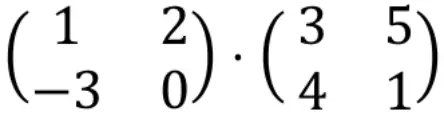
لحساب ضرب المصفوفة، يجب ضرب صفوف المصفوفة اليسرى في أعمدة المصفوفة اليمنى.
لذا علينا أولًا ضرب الصف الأول في العمود الأول. للقيام بذلك، نضرب كل عنصر في الصف الأول في كل عنصر في العمود الأول واحدًا تلو الآخر، ثم نضيف النتائج. كل هذا سيكون العنصر الأول في الصف الأول من المصفوفة الناتجة. انظر إلى الإجراء:

1 ⋅ 3 + 2 ⋅ 4 = 3 + 8 = 11. إذن:
الآن نحن بحاجة إلى ضرب الصف الأول في العمود الثاني . ولذلك نكرر الإجراء: نضرب كل عنصر من عناصر الصف الأول واحدًا تلو الآخر في كل عنصر من عناصر العمود الثاني، ثم نضيف النتائج. وكل هذا سيكون العنصر الثاني من الصف الأول من المصفوفة الناتجة:
1 ⋅ 5 + 2 ⋅ 1 = 5 + 2 = 7. إذن:
بمجرد أن نملأ الصف الأول من المصفوفة الناتجة، ننتقل إلى الصف الثاني. لذلك نضرب الصف الثاني في العمود الأول بتكرار الإجراء: نضرب كل عنصر من عناصر الصف الثاني في كل عنصر من عناصر العمود الأول واحدًا تلو الآخر، ونضيف النتائج:
-3 ⋅ 3 + 0 ⋅ 4 = -9 + 0 = -9. حتى الآن:
وأخيرا، نقوم بضرب الصف الثاني في العمود الثاني . دائمًا بنفس الإجراء: نضرب كل عنصر من عناصر الصف الثاني واحدًا تلو الآخر في كل عنصر من عناصر العمود الثاني، ثم نضيف النتائج:
-3 ⋅ 5 + 0 ⋅ 1 = -15 + 0 = -15. حتى الآن:
وهنا ينتهي ضرب المصفوفتين. كما رأيت، تحتاج إلى ضرب الصفوف في الأعمدة، مع تكرار نفس الإجراء دائمًا: ضرب كل عنصر من عناصر الصف في كل عنصر من عناصر العمود واحدًا تلو الآخر، ثم قم بإضافة النتائج.
حل تمارين ضرب المصفوفات
التمرين 1
حل منتج المصفوفة التالي:
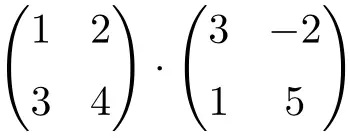
إنه منتج مصفوفات من الرتبة 2:
![\displaystyle \begin{pmatrix} 1 & 2 \\[1.1ex] 3 & 4 \end{pmatrix} \cdot \begin{pmatrix} 3 & -2 \\[1.1ex] 1 & 5 \end{pmatrix}](https://mathority.org/wp-content/ql-cache/quicklatex.com-747926b92c1d388c1150613b0f471d7e_l3.png "Rendered by QuickLaTeX.com")
لحل منتج المصفوفة، يجب عليك ضرب صفوف المصفوفة اليسرى بأعمدة المصفوفة اليمنى.
لذلك، نقوم أولاً بضرب الصف الأول في العمود الأول. للقيام بذلك، نضرب كل عنصر في الصف الأول في كل عنصر في العمود الأول واحدًا تلو الآخر، ثم نضيف النتائج. وكل هذا سيكون العنصر الأول في الصف الأول من المصفوفة الناتجة:
![\displaystyle \begin{pmatrix} 1 & 2 \\[1.1ex] 3 & 4 \end{pmatrix} \cdot \begin{pmatrix} 3 & -2 \\[1.1ex] 1 & 5 \end{pmatrix} = \begin{pmatrix} 1\cdot 3 +2 \cdot 1 & \\[1.1ex] & \end{pmatrix} = \begin{pmatrix} 5 & \\[1.1ex] & \end{pmatrix}](https://mathority.org/wp-content/ql-cache/quicklatex.com-eff23eaf91738d6ffb383949e4b70856_l3.png "Rendered by QuickLaTeX.com")
الآن دعونا نضرب الصف الأول في العمود الثاني للحصول على العنصر الثاني من الصف الأول من المصفوفة الناتجة:
![\displaystyle \begin{pmatrix} 1 & 2 \\[1.1ex] 3 & 4 \end{pmatrix} \cdot \begin{pmatrix} 3 & -2 \\[1.1ex] 1 & 5 \end{pmatrix} = \begin{pmatrix} -1 & 1\cdot (-2) +2 \cdot 5 \\[1.1ex] & \end{pmatrix} = \begin{pmatrix}5 & 8 \\[1.1ex] & \end{pmatrix}](https://mathority.org/wp-content/ql-cache/quicklatex.com-558838bcc38efc1aeeaf298d3e7151dc_l3.png "Rendered by QuickLaTeX.com")
ننتقل إلى الصف الثاني، فنضرب الصف الثاني في العمود الأول:
![\displaystyle \begin{pmatrix} 1 & 2 \\[1.1ex] 3 & 4 \end{pmatrix} \cdot \begin{pmatrix} 3 & -2 \\[1.1ex] 1 & 5 \end{pmatrix} = \begin{pmatrix} -1 & 8 \\[1.1ex] 3\cdot 3 +4 \cdot 1 & \end{pmatrix}= \begin{pmatrix}5 & 8 \\[1.1ex] 13 & \end{pmatrix}](https://mathority.org/wp-content/ql-cache/quicklatex.com-daab54a49cc53c320bb2965f691fd7ed_l3.png "Rendered by QuickLaTeX.com")
وأخيراً نقوم بضرب الصف الثاني في العمود الثاني لحساب العنصر الأخير في الجدول:
![\displaystyle \begin{pmatrix} 1 & 2 \\[1.1ex] 3 & 4 \end{pmatrix} \cdot \begin{pmatrix} 3 & -2 \\[1.1ex] 1 & 5 \end{pmatrix}= \begin{pmatrix} -1 & 8 \\[1.1ex]1 & 3\cdot (-2) +4 \cdot 5 \end{pmatrix}=\begin{pmatrix} 5 & 8 \\[1.1ex] 13 & 14 \end{pmatrix}](https://mathority.org/wp-content/ql-cache/quicklatex.com-a85e0d62a0db18c7712fd1b354f92bd5_l3.png "Rendered by QuickLaTeX.com")
وبالتالي فإن نتيجة ضرب المصفوفة هي:
![\displaystyle \begin{pmatrix} \bm{5} & \bm{8} \\[1.1ex]\bm{13} & \bm{14} \end{pmatrix}](https://mathority.org/wp-content/ql-cache/quicklatex.com-76f1283db0175bc1a95b0a10c8961761_l3.png "Rendered by QuickLaTeX.com")
تمرين 2
أوجد نتيجة ضرب المصفوفة المربعة 2×2 التالية:
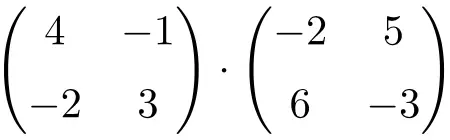
إنه منتج مصفوفات البعد 2 × 2.
لحل عملية الضرب، عليك ضرب صفوف المصفوفة اليسرى في أعمدة المصفوفة اليمنى:
![\displaystyle \begin{aligned} \begin{pmatrix} 4 & -1 \\[1.1ex] -2 & 3 \end{pmatrix} \cdot \begin{pmatrix} -2 & 5 \\[1.1ex] 6 & -3 \end{pmatrix} & = \begin{pmatrix} 4\cdot (-2)+(-1) \cdot 6 & 4\cdot 5+(-1) \cdot (-3) \\[1.1ex](-2)\cdot (-2)+3 \cdot 6 & (-2)\cdot 5+3 \cdot (-3)\end{pmatrix} \\[2ex] & =\begin{pmatrix} \bm{-14} & \bm{23} \\[1.1ex]\bm{22} & \bm{-19} \end{pmatrix} \end{aligned}](https://mathority.org/wp-content/ql-cache/quicklatex.com-fc7217dab49f67df2a9d2abc561baf9d_l3.png "Rendered by QuickLaTeX.com")
التمرين 3
احسب ضرب المصفوفة 3×3 التالية:
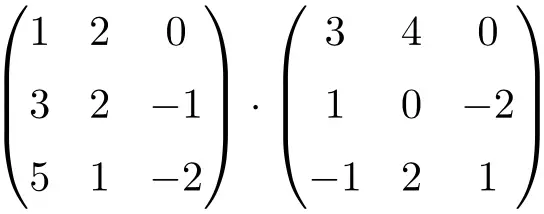
لإجراء عملية ضرب المصفوفة 3×3، يجب عليك ضرب صفوف المصفوفة اليسرى في أعمدة المصفوفة اليمنى:
![\displaystyle \begin{array}{l} \begin{pmatrix} 1 & 2 & 0 \\[1.1ex] 3 & 2 & -1 \\[1.1ex] 5 & 1 & -2 \end{pmatrix} \cdot \begin{pmatrix} 3 & 4 & 0 \\[1.1ex] 1 & 0 & -2 \\[1.1ex] -1 & 2 & 1 \end{pmatrix} = \\[7.5ex] =\begin{pmatrix} 1 \cdot 3+2 \cdot 1+ 0 \cdot (-1) & 1 \cdot 4+2 \cdot 0+ 0 \cdot 2 & 1 \cdot 0+2 \cdot (-2)+ 0 \cdot 1 \\[1.1ex] 3 \cdot 3+2 \cdot 1+ (-1) \cdot (-1) & 3 \cdot 4+2 \cdot 0+ (-1) \cdot 2 & 3 \cdot 0+2 \cdot (-2)+ (-1) \cdot 1 \\[1.1ex] 5 \cdot 3+1 \cdot 1+ (-2) \cdot (-1) & 5 \cdot 4+1 \cdot 0+ (-2) \cdot 2 & 5 \cdot 0+1 \cdot (-2)+ (-2) \cdot 1 \end{pmatrix} = \\[7.5ex] =\begin{pmatrix} \bm{5} & \bm{4} & \bm{-4} \\[1.1ex] \bm{12} & \bm{10} & \bm{-5} \\[1.1ex] \bm{18} & \bm{16} & \bm{-4} \end{pmatrix}\end{array}](https://mathority.org/wp-content/ql-cache/quicklatex.com-ef6ee7bb6e4ac095a9fd51a545b163b0_l3.png "Rendered by QuickLaTeX.com")
التمرين 4
نظرا للمصفوفة

:
![\displaystyle A= \begin{pmatrix} 3 & 1 & -2 \\[1.1ex] 4 & 2 & -1 \end{pmatrix}](https://mathority.org/wp-content/ql-cache/quicklatex.com-27365f9993caf4fcdb747352e4ae539d_l3.png "Rendered by QuickLaTeX.com")
احسب:

سنقوم أولاً بحساب مصفوفة النقل لـ
للقيام بالضرب. ولإنشاء مصفوفة تبديل، نحتاج إلى تغيير الصفوف إلى أعمدة. أي أن الصف الأول من المصفوفة يصبح العمود الأول من المصفوفة والصف الثاني من المصفوفة يصبح العمود الثاني من المصفوفة. حتى الآن:
![\displaystyle A^t= \begin{pmatrix} 3 & 4 \\[1.1ex] 1 & 2 \\[1.1ex] -2 & -1 \end{pmatrix}](https://mathority.org/wp-content/ql-cache/quicklatex.com-ac4785c47f2e48e15b3d98ba426848b6_l3.png "Rendered by QuickLaTeX.com")
وبالتالي تظل عملية المصفوفة كما يلي:
![\displaystyle 2A\cdot A^t = 2 \begin{pmatrix} 3 & 1 & -2 \\[1.1ex] 4 & 2 & -1 \end{pmatrix} \cdot \begin{pmatrix} 3 & 4 \\[1.1ex] 1 & 2 \\[1.1ex] -2 & -1 \end{pmatrix}](https://mathority.org/wp-content/ql-cache/quicklatex.com-9513fa8cc6996e18e3cf287f0210817a_l3.png "Rendered by QuickLaTeX.com")
الآن يمكننا أن نفعل الحسابات. نحسب أولا

(على الرغم من أنه يمكننا أيضًا الحساب أولاً

):
![\displaystyle \begin{pmatrix} 2 \cdot 3 & 2 \cdot 1 & 2 \cdot (-2) \\[1.1ex] 2 \cdot 4 & 2 \cdot 2 & 2 \cdot (-1) \end{pmatrix} \cdot \begin{pmatrix} 3 & 4 \\[1.1ex] 1 & 2 \\[1.1ex] -2 & -1 \end{pmatrix} =](https://mathority.org/wp-content/ql-cache/quicklatex.com-ae5e95f09aedac8f0861bf13fb9c78a4_l3.png "Rendered by QuickLaTeX.com")
![\displaystyle =\begin{pmatrix} 6 & 2 & -4 \\[1.1ex] 8 & 4 & -2 \end{pmatrix} \cdot \begin{pmatrix} 3 & 4 \\[1.1ex] 1 & 2 \\[1.1ex] -2 & -1 \end{pmatrix}](https://mathority.org/wp-content/ql-cache/quicklatex.com-24c003b8da1081d6ca494adc3356b06b_l3.png "Rendered by QuickLaTeX.com")
وأخيرًا، نحل حاصل ضرب المصفوفات:
![\displaystyle \begin{pmatrix} 6 \cdot 3 +2 \cdot 1 + (-4) \cdot (-2) & 6 \cdot 4 +2 \cdot 2 + (-4) \cdot (-1) \\[1.1ex] 8 \cdot 3 +4 \cdot 1 + (-2) \cdot (-2) & 8 \cdot 4 +4 \cdot 2 + (-2) \cdot (-1) \end{pmatrix} =](https://mathority.org/wp-content/ql-cache/quicklatex.com-0eb8f1817f0163a82ae39cc6c81d478e_l3.png "Rendered by QuickLaTeX.com")
![\displaystyle = \begin{pmatrix} \bm{28} & \bm{32} \\[1.1ex]\bm{32} & \bm{42} \end{pmatrix}](https://mathority.org/wp-content/ql-cache/quicklatex.com-33533be747b72497915048e486d16541_l3.png "Rendered by QuickLaTeX.com")
التمرين 5
النظر في المصفوفات التالية:
![\displaystyle A=\begin{pmatrix} 2 & 4 \\[1.1ex] -3 & 5 \end{pmatrix} \qquad B=\begin{pmatrix} -1 & -2 \\[1.1ex] 3 & -3 \end{pmatrix}](https://mathority.org/wp-content/ql-cache/quicklatex.com-6e26aec2eee6bcae0e344682d20038f2_l3.png "Rendered by QuickLaTeX.com")
احسب:

هي عملية تجمع بين الطرح وضرب المصفوفات من الرتبة 2:
![\displaystyle A\cdot B - B \cdot A= \begin{pmatrix} 2 & 4 \\[1.1ex] -3 & 5 \end{pmatrix}\cdot \begin{pmatrix} -1 & -2 \\[1.1ex] 3 & -3 \end{pmatrix} - \begin{pmatrix} -1 & -2 \\[1.1ex] 3 & -3 \end{pmatrix} \cdot \begin{pmatrix} 2 & 4 \\[1.1ex] -3 & 5 \end{pmatrix}](https://mathority.org/wp-content/ql-cache/quicklatex.com-43f79f2d970bb02caaeddec34d5ad2a1_l3.png "Rendered by QuickLaTeX.com")
نحسب أولاً الضرب على اليسار:
![\displaystyle \begin{pmatrix} 2\cdot (-1) + 4 \cdot 3 & 2\cdot (-2) + 4 \cdot (-3) \\[1.1ex] (-3)\cdot (-1) + 5 \cdot 3 & (-3)\cdot (-2) + 5 \cdot (-3) \end{pmatrix} - \begin{pmatrix} -1 & -2 \\[1.1ex] 3 & -3 \end{pmatrix} \cdot \begin{pmatrix} 2 & 4 \\[1.1ex] -3 & 5 \end{pmatrix} =](https://mathority.org/wp-content/ql-cache/quicklatex.com-05ff586671fb0af274884169c54e5817_l3.png "Rendered by QuickLaTeX.com")
![\displaystyle= \begin{pmatrix} 10 & -16 \\[1.1ex] 18 & -9 \end{pmatrix} - \begin{pmatrix} -1 & -2 \\[1.1ex] 3 & -3 \end{pmatrix} \cdot \begin{pmatrix} 2 & 4 \\[1.1ex] -3 & 5 \end{pmatrix}](https://mathority.org/wp-content/ql-cache/quicklatex.com-43c234a2d7aa4f9dcaf3140f617480f1_l3.png "Rendered by QuickLaTeX.com")
الآن نحل الضرب على اليمين:
![\displaystyle \begin{pmatrix} 10 & -16 \\[1.1ex] 18 & -9 \end{pmatrix} - \begin{pmatrix} -1 \cdot 2 +(-2) \cdot (-3) & -1 \cdot 4 +(-2) \cdot 5 \\[1.1ex]3 \cdot 2 +(-3) \cdot (-3) & 3 \cdot 4 +(-3) \cdot 5 \end{pmatrix} =](https://mathority.org/wp-content/ql-cache/quicklatex.com-552309dd1be2f69bb72633539809283b_l3.png "Rendered by QuickLaTeX.com")
![\displaystyle =\begin{pmatrix} 10 & -16 \\[1.1ex] 18 & -9 \end{pmatrix} - \begin{pmatrix} 4 &-14 \\[1.1ex]15 & -3 \end{pmatrix}](https://mathority.org/wp-content/ql-cache/quicklatex.com-eeac84965cc522402e869234a841ba67_l3.png "Rendered by QuickLaTeX.com")
وأخيرًا نطرح المصفوفات:
![\displaystyle \begin{pmatrix} 10-4 & -16 -(-14) \\[1.1ex] 18-15 & -9-(-3) \end{pmatrix} =](https://mathority.org/wp-content/ql-cache/quicklatex.com-faefbc14fc49439616b3d131243eba79_l3.png "Rendered by QuickLaTeX.com")
![\displaystyle =\begin{pmatrix} \bm{6} & \bm{-2} \\[1.1ex] \bm{3} & \bm{-6} \end{pmatrix}](https://mathority.org/wp-content/ql-cache/quicklatex.com-50bac6ac99e1cf6e4b77a1a8718f9fe4_l3.png "Rendered by QuickLaTeX.com")
متى لا يمكنك ضرب مصفوفتين؟
لا يمكن ضرب جميع المصفوفات. لضرب مصفوفتين، يجب أن يتطابق عدد الأعمدة في المصفوفة الأولى مع عدد الصفوف في المصفوفة الثانية.
على سبيل المثال، لا يمكن إجراء الضرب التالي لأن المصفوفة الأولى تحتوي على 3 أعمدة والمصفوفة الثانية تحتوي على صفين:
![\displaystyle\begin{pmatrix} 1 & 3 & -2 \\[1.1ex] 4 & 0 & 5 \end{pmatrix} \cdot \begin{pmatrix} 2 & 1 \\[1.1ex] 3 & -1 \end{pmatrix} \ \longleftarrow \ \color{red} \bm{\times}](https://mathority.org/wp-content/ql-cache/quicklatex.com-b8314f9238afb3676bee5c9000c02752_l3.png "Rendered by QuickLaTeX.com")
لكن إذا عكسنا الترتيب، فيمكن مضاعفة العدد. لأن المصفوفة الأولى تحتوي على عمودين والمصفوفة الثانية تحتوي على صفين:
![\displaystyle \begin{aligned} \begin{pmatrix} 2 & 1 \\[1.1ex] 3 & -1 \end{pmatrix} \cdot \begin{pmatrix} 1 & 3 & -2 \\[1.1ex] 4 & 0 & 5 \end{pmatrix} & = \begin{pmatrix} 2\cdot 1 + 1 \cdot 4 & 2\cdot 3 + 1 \cdot 0 & 2\cdot (-2) + 1 \cdot 5 \\[1.1ex] 3\cdot 1 + (-1) \cdot 4 & 3\cdot 3 + (-1) \cdot 0 & 3\cdot (-2) + (-1) \cdot 5 \end{pmatrix} \\[2ex] & = \begin{pmatrix} \bm{6} & \bm{6} & \bm{1} \\[1.1ex]\bm{-1} & \bm{9} & \bm{-11} \end{pmatrix} \end{aligned}](https://mathority.org/wp-content/ql-cache/quicklatex.com-37d01cc99b578d3756312c3e6ff12cae_l3.png "Rendered by QuickLaTeX.com")
خصائص ضرب المصفوفات
يتميز هذا النوع من عمليات المصفوفة بالخصائص التالية:
- ضرب المصفوفة هو ترابطي:

- الضرب في المصفوفة له أيضًا خاصية التوزيع:

- منتج المصفوفات ليس تبادليًا:

على سبيل المثال، ضرب المصفوفة التالية يعطي النتيجة:
![\displaystyle \begin{aligned} \begin{pmatrix} 1 & -1 \\[1.1ex] 2 & 3 \end{pmatrix} \cdot \begin{pmatrix} -2 & 5 \\[1.1ex] 0 & 1 \end{pmatrix} & = \begin{pmatrix} 1\cdot (-2) + (-1) \cdot 0 & 1\cdot 5 + (-1) \cdot 1 \\[1.1ex] 2\cdot (-2) + 3 \cdot 0 & 2\cdot 5 + 3 \cdot 1 \end{pmatrix} \\[2ex] & = \begin{pmatrix} \bm{-2} & \bm{4} \\[1.1ex] \bm{-4} & \bm{13} \end{pmatrix}\end{aligned}](https://mathority.org/wp-content/ql-cache/quicklatex.com-3e780b321b160ad4a612e608199a374b_l3.png "Rendered by QuickLaTeX.com")
لكن نتيجة الضرب تختلف إذا عكسنا ترتيب ضرب المصفوفات:
![\displaystyle \begin{aligned}\begin{pmatrix} -2 & 5 \\[1.1ex] 0 & 1 \end{pmatrix} \cdot \begin{pmatrix} 1 & -1 \\[1.1ex] 2 & 3 \end{pmatrix} & = \begin{pmatrix} -2 \cdot 1 + 5\cdot 2 & -2 \cdot (-1) + 5\cdot 3 \\[1.1ex] 0 \cdot 1 + 1\cdot 2 & 0 \cdot (-1) + 1\cdot 3 \end{pmatrix} \\[2ex] & = \begin{pmatrix} \bm{8} & \bm{17} \\[1.1ex] \bm{2} & \bm{3} \end{pmatrix}\end{aligned}](https://mathority.org/wp-content/ql-cache/quicklatex.com-177d78a209e5d9e18828617e4913176d_l3.png "Rendered by QuickLaTeX.com")
- بالإضافة إلى ذلك، أي مصفوفة مضروبة في مصفوفة الهوية ينتج عنها نفس المصفوفة. وهذا ما يسمى خاصية الهوية المضاعفة:


على سبيل المثال:
![\displaystyle \begin{pmatrix} 2 & 7 \\[1.1ex] -6 & 5 \end{pmatrix} \cdot \begin{pmatrix} 1 & 0 \\[1.1ex] 0 & 1 \end{pmatrix} = \begin{pmatrix} \bm{2} & \bm{7} \\[1.1ex] \bm{-6} & \bm{5} \end{pmatrix}](https://mathority.org/wp-content/ql-cache/quicklatex.com-9c1e72173419eb76554256cf6ccd0d2f_l3.png "Rendered by QuickLaTeX.com")
- أخيرًا، كما قد تخمن بالفعل، أي مصفوفة مضروبة في المصفوفة الصفرية تساوي المصفوفة الصفرية. وهذا ما يسمى خاصية الضرب للصفر:


على سبيل المثال:
![\displaystyle \begin{pmatrix} 6 & -4 \\[1.1ex] 3 & 8 \end{pmatrix} \cdot \begin{pmatrix} 0 & 0 \\[1.1ex] 0 & 0 \end{pmatrix} = \begin{pmatrix} \bm{0} & \bm{0} \\[1.1ex] \bm{0} & \bm{0}\end{pmatrix}](https://mathority.org/wp-content/ql-cache/quicklatex.com-3152d82054a80d61d548e969290aea4c_l3.png "Rendered by QuickLaTeX.com")